Scripps College Alumna Reflects on Executive Briefing
Scripps College alumna Pearl Audon reflects on her experience at the 2018 Carter Center Executive Briefing and Visit to Plains.
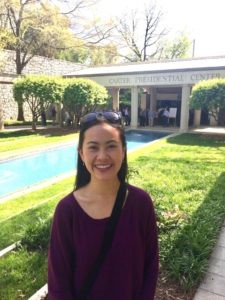 Before graduating from Scripps College, I had the amazing opportunity to meet former U.S. President Jimmy Carter and attend the 2018 Carter Center Executive Briefing and Visit to Plains, thanks to the generosity of another Scripps alumna, Ms. Barbara Bruner.
Founded by Jimmy and Rosalynn Carter in 1982, The Carter Center is a nongovernmental organization dedicated to alleviating human suffering through peace, public health, and human rights efforts in more than 80 countries. Each year, one Scripps student is selected to attend the Executive Briefing to observe the inner workings of The Carter Center, with a purpose of developing professional presence and meaningful connections. The Bruner Carter Center scholarship covers all costs, including transportation, accommodations, meals, conference fees, excursions in Atlanta, and a two-day trip to Plains. Here, I reflect on a few snippets of my scholarship experience.
The Carter Center event began with an evening conversation, “Liberia Looks to the Future.” Experts summarized the Carter Center’s involvement in Liberia’s recent election and its training of a new class of mental health clinicians. I was amazed by the eloquence and political expertise of the speakers as well as the attendees who chimed in. It became apparent that most attendees had established careers in government and health. Frankly, it was intimidating. However, I could not miss my chance to ring in on the talk, so I asked about the recent mental health program implementation in Liberia. I prefaced my question with a description of my hometown, Santa Ana, California, a community filled with Vietnamese war refugees, and how there was a gap between mental health clinicians/resources and those who needed them. Although it was just one question, this led to follow-up discussions with the attendees throughout the rest of the conference. It became less daunting once I put myself out there, remained curious, and began to tell my story.
After sessions discussing diplomacy in the Middle East and elimination of tropical diseases in Sudan, it came time to welcome President Carter for his talk. When he appeared at the door, I felt my heart palpitate, absolutely overwhelmed that I could be in the vicinity of one of the most influential people in the United States. With President Carter now in the room, what did we talk about? Many were wondering about his views on North Korea, hoping he could impart some wisdom. We think about the long-anticipated meeting between current North Korean and U.S. leaders, but Jimmy Carter actually was the first former U.S. president to visit North Korea, back in 1994. The talk continued with some back-and-forth questions from the audience about the food shortages and nuclear testing in North Korea. Though the conversation revealed few plausible solutions, President Carter’s open discussion on pertinent international relations was a rare opportunity for an undergraduate.
Visit to Plains, Georgia
Three hours south of Atlanta lies Jimmy Carter’s boyhood town of Plains, Georgia. President Carter energetically welcomed us to his high school, childhood farm, and church. We then enjoyed the city’s offerings of peach cobbler, a car show, square dancing, historical monuments, and free peanut treats. Of all the activities in the town, I highly recommend attending President Carter’s Sunday school at Maranatha Baptist Church. We had to wake up early to get checked by the Secret Service, but it was worth the wait to hear about the president’s faith.
Four days with The Carter Center proved to be an indelible and transformative experience. Not only did I meet incredible people, but I also had the chance to learn about and discuss topics that were foreign to me. Above all, I am grateful for an experience I was not expecting: following President Carter’s trajectory from his upbringing in a humble town to his presidency and, now, to his lifetime commitment to peace through The Carter Center. It gives me hope that in positions of power, and even as I proceed in my own life ventures, one can promote peace and the improvement of lives in one’s community and around the world. For this, I cannot thank Barbara Bruner enough for having me as her Carter Center guest this year.
Learn more about Executive Briefing »
Global Impact Starts with You
Your support sustains the Carter Center's mission of waging peace, fighting disease, and building hope around the world.