Podcast Episode 2: ‘Even Today, I Hate Fireworks’
Far Away, Up Close: Global Stories from The Carter Center
‘Even Today, I Hate Fireworks’
When Rana Shabb was barely a teenager, she witnessed something no child should ever have to see: war. The experience changed her life forever, and ultimately led her to a career in peacebuilding with The Carter Center.
In this episode, Rana talks about growing up in Beirut, Lebanon, and Houston, Texas. She also discusses the Carter Center’s commitment to the Middle East, using data to help demining efforts in Syria, and the work she and her colleagues do so that children all over the world can learn and play in peace.
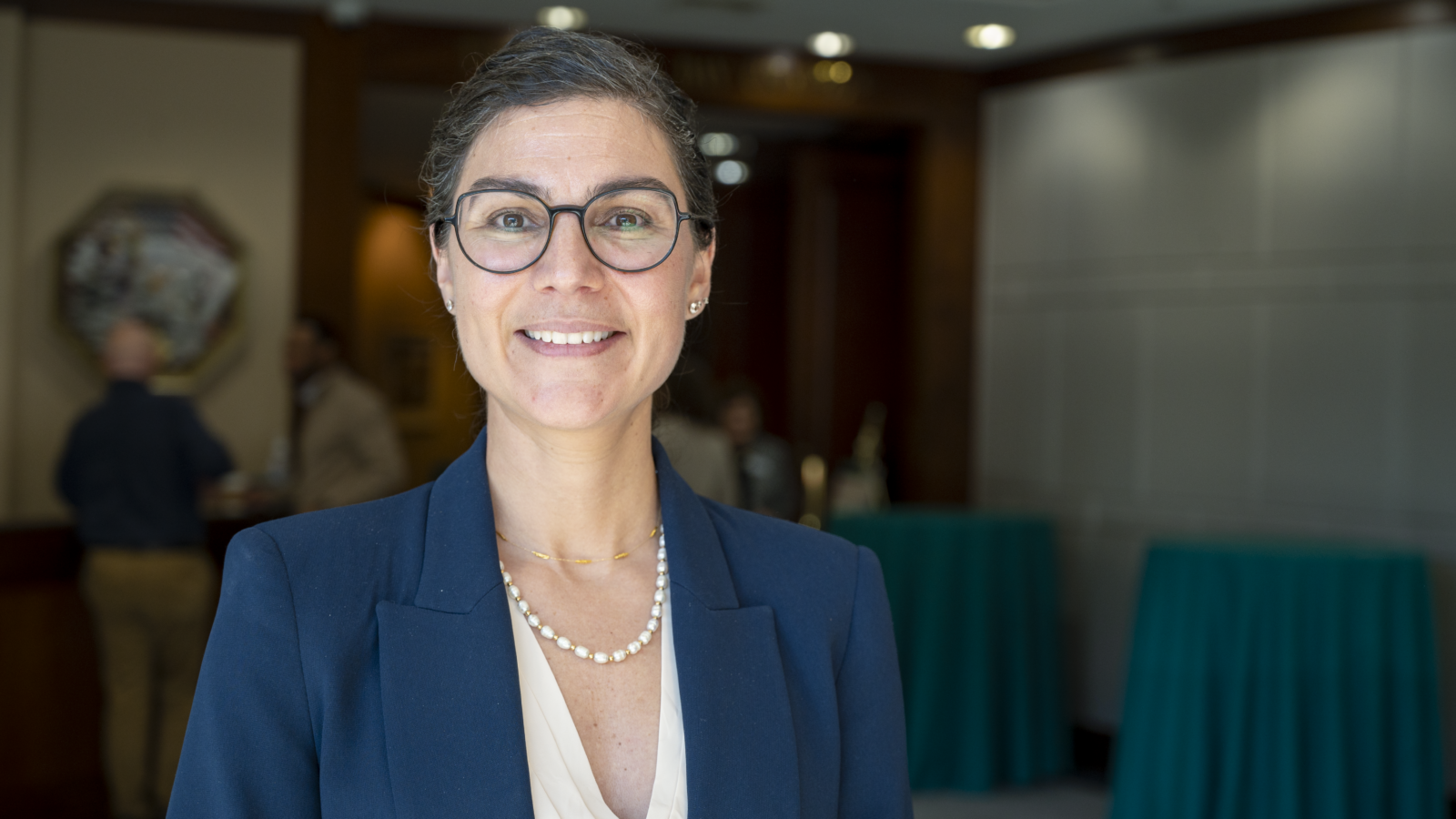
Rana Shabb
From the window, you could see the triangle that is Beirut ebbing into the Mediterranean, and you can see sparks in the sky, curdles and curdles and curdles, if you will, of smoke. Watching the scene unravel was definitely a moment of, “Am I dreaming, is this real? Is it a movie? Is the next strike going to be us or closer?” So staring down at the fireworks in the sky that are not really fireworks was something that, as a child, really shocked me to my core.
Soyia Ellison, Host
When Rana Shabb was barely a teenager, she witnessed something no child should ever have to see — war. It changed her life forever and ultimately led her to a career in peacebuilding with The Carter Center. This is “Far Away, Up Close: Global Stories from The Carter Center.” I’m your host, Soyia Ellison, director of storytelling at the Center. In this podcast, Carter Center staff share stories in their own words, not just about their work, but also about the lives that led them to it. In today’s episode, Rana talks about growing up in Beirut, Lebanon, and Houston, Texas; the Carter Center’s commitment to the Middle East; and the work she and her colleagues do so that children all over the world can learn and play in peace.
Rana Shabb
I’m Rana Shabb. I’m the associate director for the Middle East and data analysis at the Carter Center’s Conflict Resolution Program. I’m based here in Atlanta, Georgia, where Jimmy and Rosalynn Carter are from. A lot of my work consists of very close coordination and communication with our local partners in Syria but also in Israel-Palestine, and project management to bring about sustainable and inclusive peace in the region.
I’m both Lebanese and American. I grew up in Texas first and Beirut second. My parents were both medical doctors. They studied in Beirut, Lebanon, until they were forced out by war, 1982. And so they got on a ship headed toward to the United States and continued their medical degrees in Texas.
At the time, there was a civil war raging in the background, the Lebanese Civil War, which ended in 1990. So as soon as the civil war ended, my parents packed their things and their children, and they moved back to Lebanon to be part of the new beginning. I was almost 8 years old when the civil war ended.
There was a culture shock always to move back. My English was very American, and so the kids in my class thought I sounded funny. I had to pick up Arabic and French almost on the fly and to compete in school because Lebanon was a French colony. So I just remember it being a very challenging time, but a very special time, because your brain as a child is very sponge-like, and so I became trilingual in a few years and got to be with my grandparents. On my maternal side, my family was into political science and into the notions of peacebuilding. And then on my father’s side was a very heavily medical family that was involved in providing care to anyone who needed it under a civil war context. So I had a beautiful childhood with amazing role models.
My mom was very adamant on almost this ritual every weekend, so we would depart the sound and pollution of Beirut city and head up towards the olive trees. Going up to the northern part of Lebanon, particularly a small village outside of Tripoli, that’s where my mother is from, her father is from. Driving up to the village, I actually loved the feeling of being squished between my sisters in the back seat. No one forces you to sit like that at home, but when you’re in the car, it’s kind of a forced moment of intimacy.
We brought Texas to Lebanon. We were big fans of country music, particularly George Strait. “All My Ex’s Live in Texas.” That’s one thing that we were humming out loud on the way to the olive groves.
This is the era of globalization. We were raised in the United States, so we actually desired the Nike Air Pumps, and we looked like little ’90s kids.
The village is centered around olive oil. We’d spend the weekend walking through the olive trees and the plains, the wildflowers. It smells particularly beautiful when it rains and the mud becomes wet and there is that release of an earthy scent. There is absolutely no rain in the summer. It’s very, very dry. But then when the spring comes, the carpet under the olive trees turns into a lavish green and then into the wild colors of wildflowers: purple, white, yellow. So there is that moment of lush beauty that you just have to capture because you know the summer is going to get it.
We lived right outside of Beirut on a hilltop, and what that provided us was a balcony with a beautiful view on the city, on the Mediterranean, and on the sunset. And so as a family in the summers, that’s where we had dinner, outside overlooking the city. As good Lebanese, we dumped tons of olive oil on everything, on labneh, on hummus, on baba ghanoush. And one thing that we were proud of is we never had to buy it. We made our olive oil ourselves, and it’s that beautiful see-through fluorescent green that sits there on the counter like, this is our olive oil.
Back in the early ’90s, I would say that we were on a high, and maybe so were my parents. They were happy to be back and be part of the rebuilding. And so the time was overly optimistic and positive. Studies of civil war show that once you’ve experienced it once, you’re at a 40% chance of relapse within the next decade. In terms of, even though a civil war has ended, propensity for violence is actually quite high.
Newscast
Good evening. With each passing day, the situation along the Israeli-Lebanese border grows more unstable and more dangerous. Israel continues its massive air attack on southern Lebanon while Hezbollah responds with a torrent of Katyusha rockets aimed at northern Israel…
Rana Shabb
I remember darkness and lights in the sky, and from the balcony, you could see the triangle that is Beirut ebbing into the Mediterranean, and you can see sparks in the sky, and then clouds of smoke emerging from the distance. You can’t exactly see is it a building or what has been hit, but you can see that something has been hit, and there are curdles and curdles and curdles of smoke. It was Israel hitting Hezbollah targets in Lebanon.
Watching the scene unravel was definitely a moment of, “Am I dreaming? Is this real? Is it a movie? And then a part of me is, am I going to be hit with the smoke? Is the next strike going to be us or closer?” And I think many can relate kind of to the 9/11 scene where, again, was this actually happening? Staring down at the darkness and all the fireworks in the sky that are not really fireworks was something that, as a child, really shocked me to my core.
And I’m the oldest of four girls. This is 1996, so I was a young teenager at the time, and I did think of myself kind of like as the boss or the protector of my sisters. And so one of the first feelings was, “They can’t see this. What does this mean for us? Can we continue to live here? Are we going to go to school tomorrow? Can my parents go to work tomorrow? Are we going to be able to eat in a few days?”
Jimmy Carter said that war is the greatest violation of human rights, and those words really resonate with a feeling of that moment, that this is not right, it shouldn’t be, and it shouldn’t be for anybody, for any person, for any child, anywhere.
So that’s the moment that shapes my childhood and what I choose to be when I grow up. This was the first moment that made me realize that maybe I can’t grow old next to my parents, and maybe I don’t want to raise my children in such an environment where I am absolutely helpless in providing for their security. So that’s one element that actually pushed me to come to the United States for my undergraduate degree.
And then, on the more systemic front on what I want to do with my life, I knew that I wanted to somehow make what happened unhappen or prevent future such scenarios from happening. Because if you don’t work to prevent it, it’s going to happen again, and it’s going to create this continuous downward cycle of violence for children, for adults, for everyone concerned. Even to today with my own children, I hate fireworks so much because I grew up in a place where it’s difficult to tell the difference.
You have to be a seasoned connoisseur. And so I remember actually visiting family much later, and this is in a more recent war, we were visiting Beirut and having dinner outside, and there were sounds at a troubled time outside. And everybody at the restaurant is looking at each other, looking for who has expertise to discern between gunfire and fireworks. And the waiter was very confident: “No, no, I know this. This is fireworks. Everybody calm down. We’re good.” And so just those sounds to me are very, very uncomfortable. The fact that we even have to take a second to see if we need to discern between, “Is this an attack or is this festive? Is this a wedding, or is this creating internally displaced people?”
One of the cornerstones of the foundation of The Carter Center was to build a mini Camp David here down in Atlanta, a sanctuary and a place where people could come to in order to resolve difficult and challenging issues. And one way we do this is through the Carter Center’s ability to provide a safe and neutral space for dialogue and discussion. And really that is so important in order to come with creative solutions to a conflict or to a challenge.
In Syria, in Israel-Palestine, and Sudan, Mali, and other places we work on conflict resolution, one of the cornerstones of our slogan is waging peace, and waging peace cannot be done overnight. One thing that President Jimmy Carter brought to the table was his dedication to building peace and his dedication to certain areas.
When the Syrian conflict was 11 years in, 12 years in, there was something that was called Syria fatigue. People are just tired of thinking about a conflict or how to address a conflict. It’s easy to walk away because it looks like there’s no end in sight.
Newscast
For over a decade, Syria has been at the heart of a conflict that has reshaped the Middle East. The regime of President Bashar al-Assad, once seen as unshakable, now teeters on the brink.
On Dec. 8 of 2024, the dictatorship of the Assad family collapsed, paving the way for a new transition. Syria emerged from over 14 years of civil war. If you are 20 in Syria today, most of your memory is war, displacement, and violence. And so moving forward, it is critical that this transition is leveraged for good.
Our first time back into Damascus after the fall of the regime was May of 2025. And I had been in and out of Damascus as a kid many times because, funny enough, I had to go there to renew my U.S. passport in the ’90s, and I remember the oppressive atmosphere of you can’t say much because it’s a dictatorship. I remember my parents hushing me, like, “Don’t look too long, don’t stay too long.” And then going in as an adult was night and day. The smiles at passport control were from ear to ear, like the Syrians themselves were open door, come in and see for yourselves, this is the new Syria. And so it was a very euphoric moment, like to go in on that kind of a wave of smiles and openness and welcomeness.
Peace can be constructed through top-level negotiations, but if there is no buy-in to those agreements, it’s as if nothing happened. And so it’s very important to work at several levels to assure that an intervention is speaking not only to what the leadership of those countries need to see happen, but also to what’s feasible, to what’s implementable, to what’s sellable, to what has legitimacy. And so at the Conflict Resolution Program, we really make sure to look at the conflicts in which we work in this holistic manner, to make sure that we are coming up with not just lofty but implementable solutions.
One way is through the Carter Center’s data collection abilities. This will sound boring, but it has real-world, really quite amazing impact. The Carter Center has been collecting conflict event data. We’ve been collecting day by day, row by row, village by village that there was an airstrike on this village on this date. There were armed clashes in this town at this date. Another aerial bombardment, etc. So if you can imagine a massive Excel sheet, that’s what The Carter Center has in terms of a very granular and detailed data set on the Syrian conflict. And so you can estimate where unexploded ordnance or remnants of war lie across Syria.
We know that over 1 million munitions have been used in the Syrian war, and this leaves behind over 300,000 unexploded munitions scattered throughout the country. So all that shiny stuff you see in the sky, some of it will fall to the ground and fail to explode at a certain percentage rate. These remnants of war are a danger to the civilian population, to returnees long after the war has ended. The weapon was dispatched 10 years ago, 20 years ago, sometimes even in World War II, and it’s a shiny piece of metal in the ground. They range from big to small. And if you pick up and touch it, if you fall down and touch it, it’ll explode, and it’ll either kill you, maim you, blind you. You’ll lose your hands or a limb.
The Carter Center has been able to extrapolate where these remnants of war are across Syria, and we have been sharing that information with demining organizations to help prioritize where they should focus. Because if you focus on the most heavily contaminated areas, that means that an agricultural field, olive groves for example, can be cleared and then the farmer could return to farming the land. Or if there has been a school that’s been hit: If you clear the school from these remnants of war, then the school can be reopened for children to access. Carter Center’s methodology to predict this really is the first layer of information that’s going to the boots on the ground that are doing the actual work of demining.
The interesting and beautiful thing is that this is a replicable methodology. And so one thing that we are looking to do is to take what we did in Syria and see if we can apply in other conflict contexts like Sudan, Ukraine, Mali, or wherever. We’re also getting into how can we automate some of this data collection and classification so we can leverage AI tools so we can become faster and better at what we do.
One other thing that The Carter Center does, particularly in Syria, has been providing safe spaces for dialogue and really bringing people around the table that don’t typically do so to discuss critical matters that have a life-changing effect in the life of Syrians.
And so one example is the effect of sanctions on access to education in Syria. Syria, before the fall of the regime, was the most heavily sanctioned country in the world, very isolated from the world. And sanctions have effects on the societies on which they are imposed. One space that The Carter Center was trying to make sure remains protected from sanctions is access to education for Syrian children.
What are the low-hanging fruits that we can all talk about and agree upon at a table? And then hopefully those findings can escalate into influencing political agreements or sanctions policy towards Syria.
Soyia Ellison
Rana and a colleague returned to Syria again in 2025, just as the U.S. announced plans to lift sanctions on the country.
Rana Shabb
We got caught in the public square of Damascus in a fury of joy, of euphoria, hugs and kisses in the street, because hallelujah, sanctions were to be lifted. And this would provide Syria, at the time, the opportunity to come back economically, politically. Because if you were to imagine back then, if you lived in Damascus, you would have access to less than four hours a day to electricity. So if you had to wash your clothes, you have to schedule your washing machine at the same time of the middle of the night that the electricity is connected to wake up and run everything you need to do that’s electricity related.
And all of this is linked to sanctions and access to energy and access to trade. And so just being there at that moment in a public square where, impromptu, in a spontaneous way, Syrians are running down to the street and celebrating the lifting of sanctions, whereby The Carter Center had been advocating for the protection of Syrian civilians from the negative effect of sanctions, was really just a beautiful moment professionally and personally.
One thing that keeps me going in these difficult times that we work in, not only difficult times but difficult places, is the vision of our founder and that really we are a safe space of individuals that are like-minded and committed to living out that vision of building hope, waging peace, and fighting disease in the world. Coming to work every day and working alongside my colleagues brings me hope. But also working directly with communities on the ground and touching a life, one soul at a time, is something that very much fuels the fires of continuing this work, so no child should witness violence in the way that we are seeing unfold in front of our eyes today.
To quote Jimmy Carter, who said that war is the greatest violation of human rights and that a child’s a child no matter where they are, no matter where they live, the sanctity of childhood is to be respected wherever it is. And so the prevention of conflict, wherever it is, is the duty of our generation; it is the duty of the adults.
Soyia Ellison
That’s all for this episode of “Far Away, Up Close.” Thanks for listening.
I’m your host, Soyia Ellison.
The series is a presentation of The Carter Center in partnership with Audiation.
Sandy Smallens of Audiation and I are the executive producers.
Our story editors are Susie Armitage and Andre Gallant.
Our series producer and audio video editor is Colleen Cox.
Sound design, mix engineering, and theme and original music composition by Paul Vitolins and Marcelo De Oliveira for Audiography.
Madeline Evans is our production coordinator.
Audience development by Jacob Kramer-Duffield, podcast cover art by Matt Zivkovic for Matia.
We’d like to thank all of our story subjects who so generously shared their time and lives with us.
Video Trailer
Coming Soon
Our next episode arrives in two weeks. Join us to hear Stephen Ohidor in Episode 3: ‘That Was the Chicken I Paid to the Driver.’
Related Tags
Need more inspiration and hope in your life?
Subscribe to “Far Away, Up Close” wherever you listen so you never miss an episode.
Global Impact Starts with You
Your support sustains the Carter Center's mission of waging peace, fighting disease, and building hope around the world.