Reflections on a Rich History: The Carter Center and Guyana
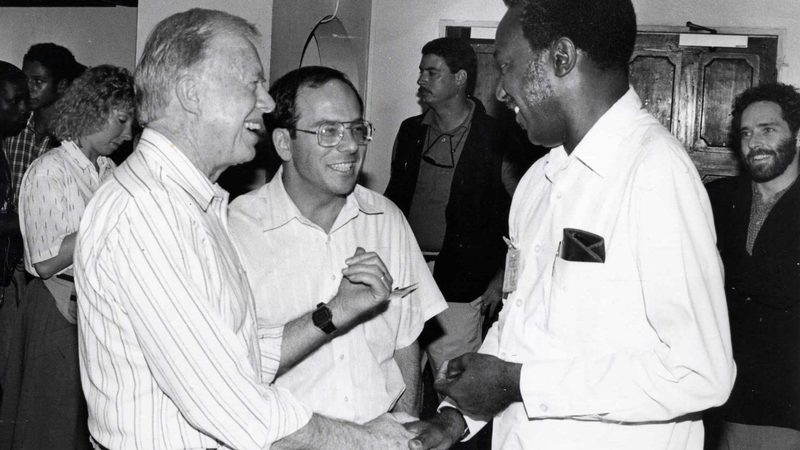
President Carter and Robert Pastor meet with Elections Commission Chairman Rudy Collins in Guyana during the Center’s 1992 election monitoring mission. (Photo: The Carter Center)
In 1990, an unannounced visitor arrived in Atlanta, Georgia, and strolled up to The Carter Center on a mission. The late Cheddi Jagan, a historic figure in Guyanese politics who later went on to become president of the South American country, had an important ask.
He’d seen how the Center helped bring free and fair elections to Nicaragua and Panama, and he hoped his beloved nation might get assistance, too.
Several months later, former U.S. President Jimmy Carter accepted an official invitation from Guyana to support negotiations around new laws and eventual elections. His first trip there marked the start of a committed relationship that continues to this day.
The Center went on to monitor six elections in Guyana, the first in 1992 and the most recent one a year ago, in September 2025. During the 2025 observation mission, the communications team invited Guyanese leaders from across the political spectrum to talk about President Carter and the Center’s history with their country.
Not everyone accepted the invitation, but each person who did helped illustrate how The Carter Center helped the Guyanese people pave their country’s road to democracy.
The Frontlines of Change
After winning its independence from British rule in 1966, Guyana suffered decades of deeply flawed elections. Ethnic tensions that had been stoked by colonial powers left a legacy of distrust.
Between 1990 and 1992, the Center helped facilitate key reforms that included counting ballots first at polling places, establishing a fresh voters list, and building an election commission to represent both the ruling and opposition parties. These efforts brought Guyana its first democratic election in decades, though the air of suspicion around elections remained thick and tensions endured.
During the counting and tabulation process in 1992, violence erupted outside the Guyana Elections Commission building, which forced the counting to stop.
Hari “Ralph” Ramkarran, a member of the Elections Commission at the time, was there and remembers the growing crowds that stoned the building, forcing people inside to leave, and how President Carter intervened to encourage Guyana’s then-president to enlist police to defuse tensions.
Hear Ramkarran describe President Carter’s bravery and leadership as election officials went back to work in the wee hours of the night.
When the results were finalized, and concerns about potential violence returned, again President Carter proved pivotal, helping ensure acceptance of the results.
Retired Maj. Gen. Joseph Singh, the chief of staff of the Guyana Defence Force during this time, proved a trusted sounding board, someone uniquely positioned to help facilitate a smooth handover of power. He and President Carter formed a lasting bond, one that often centered on caring about people outside political spheres.
“It wasn’t just about elections. … It was empowering women, youth, the Indigenous people,” Singh said. “My relationship with him is one of the treasured experiences of my life.”
Listen to Singh describe how the traits of President Carter live on in Board Chair Jason Carter and the Carter Center’s work.
Pivotal Change
Since monitoring that first election, the Center has remained engaged in strengthening Guyana’s electoral process, embarking on observation missions in 2001, 2006, 2015, 2020, and 2025. The 2015 Guyanese election was the Center’s 100th observation mission, and it was President Carter’s last — which was cut short after he fell sick. He was medically evacuated from the country on the eve of the election and, soon after, received a brain cancer diagnosis.
The 2015 election was also pivotal in that it marked the first change in government since 1992, demonstrating that in a democratic society, the will of the people determines who’s in charge.
Honoring the Guyanese people extended beyond recognition of their votes when it came to President Carter’s work, said Vincent Alexander, who’s served as a member of the Elections Commission for more than 17 years.
“He went beyond electoral matters and sought to look at the humanity,” Alexander said. “He played a major role in bringing together the Guyanese for the purpose of a National Development Strategy. Unfortunately, we didn’t do very much to make the strategy work, but he did a lot to bring us together in an attempt to have a collective expression as to where we want Guyana to go.”
Hear Alexander reflect on what differentiates The Carter Center from other election observation groups.
Empowering People
Elections in Guyana have not always gone smoothly. In 2020, election observers raised concerns about transparency and attempted fraud, an issue that took more than five months to resolve. And while the 2025 election was the most seamless to date, the Center has since issued a report and met with stakeholders in Guyana, encouraging constitutional reforms to address the composition of the Elections Commission, campaign finance reforms, and more to strengthen Guyana’s democracy.
“Elections are really a report card on democracy. They are not the democracy itself,” said Jason Carter, President Carter’s grandson, chair of the Center’s board of trustees, and leader of the 2025 Guyana mission. “It’s up to the people of Guyana … to decide which of those recommendations they take.”
Part of what engendered trust in President Carter and the Center has been this level of respect for the those living in Guyana, a commitment to empowering them.
President Carter “was always willing to speak, most importantly, truth to power,” said Jocelyn Dow, a former member of the Elections Commission. “I did not feel, and I think most people didn’t feel, he had come here with a stick of an American agenda, and that was really important for a country that had a deep history of intervention as Guyana had.”
Hear more from Dow about her impressions of President Carter.
Offering Hope
Today, Guyana, which discovered offshore oil in 2015, is on the world’s radar screen. But getting Americans to care about its well-being decades earlier proved a challenge.
“We weren’t important enough,” said Gail Teixeira, current minister of parliamentary affairs and governance in the Guyanese government, who served as the assistant to Cheddi Jagan in 1990, when he traveled to Atlanta to knock on the Center’s door.
President Carter and the Center took notice, she said, and stood by Guyana when others didn’t care.
Hear Teixeira explain why President Carter’s involvement was necessary to see change.
Related Resources
Other Voices from Guyana
Watch Dr. Steve Surujbally, a former longtime chair of the Elections Commission, recall the first time he met President and Mrs. Carter soon after the 1992 election.
Watch Gerry Gouveia, a former chief pilot with the Guyana Defence Force, businessman, and national security advisor describe what President Carter’s first visit meant to him.
Watch Ganesh Mahipaul, a member of parliament and 2025 vice presidential candidate for the A Partnership for National Unity (APNU) Party, speak about the legacy of President Carter.
More Stories
Global Impact Starts with You
Your support sustains the Carter Center's mission of waging peace, fighting disease, and building hope around the world.