Podcast Episode 4: ‘How Do You Tell a Child, ‘Hey, They Killed Your Mom’?’
Far Away, Up Close: Global Stories from The Carter Center
‘How Do You Tell a Child, ‘Hey, They Killed Your Mom’?’
In 1994, when Olivia Mugenga was a baby in Rwanda, she and her family were targeted in the genocide against the Tutsis, one of history’s worst atrocities. As the government and media preached hate, extremist Hutus went house to house, killing their Tutsi neighbors. Olivia’s mother and most of her relatives lost their lives in the massacre.
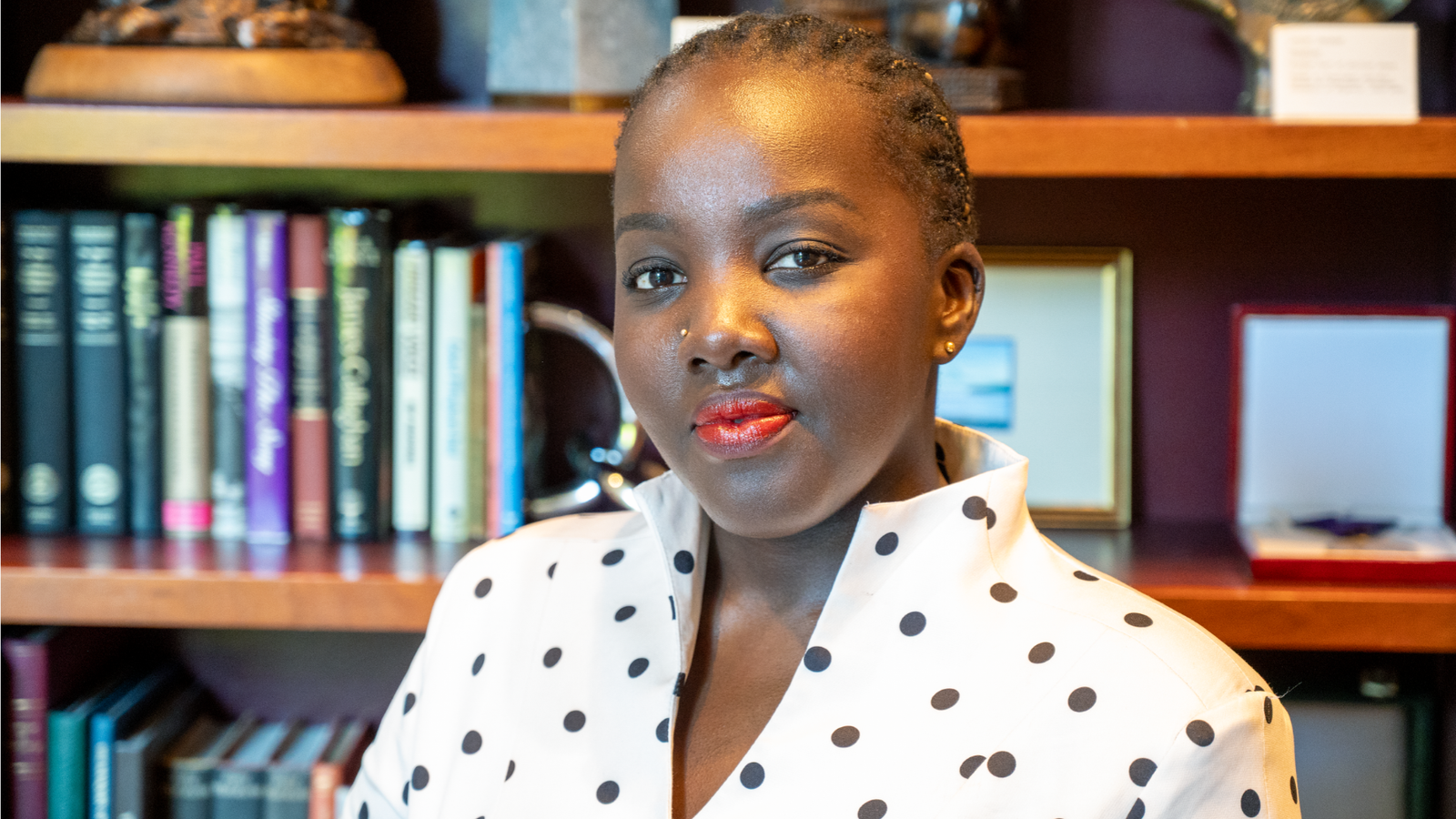
Today, as a member of the Carter Center’s overseas operations team, Olivia is part of the backbone that makes the Center’s work possible, helping keep staff safe and secure around the globe.
In this episode, Olivia talks about growing up after the genocide, her mother’s legacy, and what it’s like to support the Carter Center’s programs worldwide.
Olivia Mugenga
I found a wedding picture of my parents. In the picture, there are nine people, of the nine, only three survived. Where’s my mom? She’s not here. I knew she was a victim of the genocide against Tutsis in 1994, but what happened? Who was she before? How do you tell a child, “Hey, they killed your mom”? Why? “Because she’s a Tutsi.” Why? “Because they didn’t like Tutsi.” So how do you explain? It’s such a difficult conversation to have.
Soyia Ellison
Olivia Mugenga grew up in Rwanda in a family motivated by service to others. In 1994, when she was just a baby, they were targeted in one of history’s worst genocides. As the government and the media preached hate, extremist Hutus went house to house killing their Tutsi neighbors. As many as one million Tutsis were murdered, including Olivia’s mother and almost all her relatives. That experience led Olivia to a career in human rights. Today, as a member of the Carter Center’s Overseas Operations team, she’s part of the backbone that makes all of our work possible, by supporting the safety and security of staff around the globe. This is “Far Away, Up Close: Global Stories from the Carter Center.” I’m your host, Soyia Ellison, director of storytelling at the Center. In today’s episode, Olivia talks about growing up after the genocide, her mother’s legacy, and what it’s like to support the Carter Center’s programs around the world.
Olivia Mugenga
My name is Olivia Mugenga, and I am based in Atlanta, Georgia. At The Carter Center, I’m part of the Overseas Operations team, which is a team comprised of about 15 people. And we are a very diverse group, we have somebody from Ethiopia, me from Rwanda, somebody from Saudi Arabia, and we are in charge of supporting the operations of our 16 country offices. In my personal role, I am part of the global security team, which helps support things ranging from something as drastic as when there’s a coup d’etat or a war breaks in the region we’re in, and we need to evacuate our staff, or something as small as the personnel needs to be trained on the first aid safety, those kind of things. We are in Sudan, where there’s a war that broke. We are in Mali, where there’s a terrorism issue. And in order to operate in those zone, it’s important that staff is ready.
If you get kidnapped, what do you do? Typically, all of the staff of The Carter Center undergoes the same training. HEAT training is Hostile Environment Awareness Training, that’s what the acronym stands for. And it’s crucial for NGOs that operate in countries that are high risk. They love to do this thing where they say, “OK, training is over, thank you so much for participating.” And then you relax a little bit, you drink water, and then, boom, they kidnap you, they put a bag over your head. They’re actually actors. People cry, people break down. Me, I was too stunned to break down, I was too [laughs]. Because they had said it intense, but I thought they mean it’s long and boring, I didn’t think they mean I may fear for my life. There’s also a checkpoint scenario, where you’re in a car and then basically actors acting as terrorists are stopping you. They’re pushing you, they’re intimidating you, they’re like, “Who are you? Oh, Americans again here.” Expressing the anti-American sentiment that happens in some of the zones we work in. These are the type of real-life situations that happen.
I personally have been on seven missions so far and all of them have been in Africa. We’ve been to Nigeria, we’ve been to Cameroon, so I’m very blessed because I get to travel in this role, and particularly in Africa, which makes me feel like I’m contributing to the development of Africa.
Typically, when we’re traveling in these missions, it’s either to offer trainings, like the trainings we mentioned, or to enforce a security culture. For example, you can find that in offices there is maybe a fire extinguisher, but it can have been expired for the past four years. Or maybe it exists, but nobody knows where it is. We don’t want to think of worst-case scenarios until they present themselves, but the world we live in, it’s inevitable that things will happen. So it’s always important to manage risk before a crisis ensues.
I grew up around a lot of injustice. My dad had managed to send us to private schools; we were blessed to have access to those kind of privileges. But just when you step outside, waiting for somebody to pick you up, you watch a mother, barefoot, carrying a baby on her back, and selling mangoes on her, it’s on her head. That image is everywhere, at all times, forever. Seeing a genocide, seeing poverty, growing up, seeing those things, early on I knew that I wanted to contribute as much as I can. If I can contribute to assisting a doctor who’s going to end Guinea worm so somebody doesn’t lose a limb in a Chadian village, then I have done my part. So I grew up seeing poverty at a level that’s different from the U.S. I’ve always wanted to be in the NGO world, I wanted to contribute to the betterment of society.
When my dad was going to school, he could be maybe the first of the class, and he would be refused to pass. They would read names and say, “Identify yourself, Tutsi or Hutu?” And then when you’re Tutsi, they would not let you pass. So access to education was refused to Tutsi kids, and so a lot of them would try and go to neighboring Burundi. My dad did it like that, and my mom did it like that, and that’s actually where they met. I was born here in ’92, in Indiana. South Bend, Indiana, and my parents were going to school there, they were enrolled in their doctoral programs. My parents were very much like, the only way out of poverty is school, so let me go all the way. Let me just max out. But then in March ’94, they went on what they thought was a vacation. My mom wanted to go see her mom, my grandmother, who was sick. A month later, the genocide against Tutsis erupted, so we were trapped.
Archival News Announcer
Scars across Africa’s midsection as ethnic hatred sparks an unprecedented crisis. In Rwanda, Hutu tribal members go on a killing spree against the minority Tutsi tribe. The massacre sparked by the death of Rwanda’s president, Juvénal Habyarimana, a Hutu, in a suspicious plane crash. Corpses pile up at churches, clogging Rwanda’s rivers.
Olivia Mugenga
It was neighbor to neighbor killing. It was essentially, kill all of the Tutsis you know pretty much. The radio would basically name the lists of the Tutsi families that need to be killed, that they had identified. In this neighborhood, these are the names: A, B, C, D. That blows my mind that you can, as a functioning human in a society, can sit and name names of people who need to be murdered. And that a listener can hear those names and go act on it is beyond me. And they would say things like, “Let the future generations ask what a Tutsi looked like.” It’s insane when you think about it. There is no comprehending this horror that befell our nation. I found a wedding picture of my parents. In the picture, there are nine people. Of the nine, only three survived. So growing up, we had lost our mom in the genocide, and her mom, and her six siblings, there were seven siblings, only one survived: my aunt here in Georgia.
On my paternal side, my dad survived, and his couple siblings. My grandmother had eight children, now she has three remaining. I don’t know if it’s in every post-genocidal society, but in my family, there was a deafening silence. Where’s my mom? She’s not here. I knew she was a victim of the genocide against Tutsis in 1994, but what happened? Who was she before? How do you tell a child, “Hey, they killed your mom”? Why? “Because she’s a Tutsi.” Why? “Because they didn’t like Tutsi.” So how do you explain? It’s such a difficult conversation to have. So he just, as many Rwandan parents I’ve seen, just kind of skip it. Now, when I was a teenager, around maybe 14, I started asking a lot of questions that I wanted to understand: How did we survive?
I would ask it like it’s a movie, but it’s his life. “Hey Daddy, so you guys were just sitting like this and there is war? How did it happen? Then you start running?” So he explains that the hatred against Tutsis was not just born in one day, there had been discriminations, there had been killings and discriminations since the ’50s, but not to the scale of 1994. He would of course tell me in a way that’s kid-friendly as much as he can, and he would even try to make it a little mild, and sometimes he would throw jokes in there, which is iconic, because how do you make me smile in the middle of this horrific story?
I’ve heard this from a lot of Tutsis in 1994, basically they had resigned themselves. They had killed so many people that everybody had accepted death, like, you know what? They’ll just kill me. But the strategy that they took on was, I won’t be scared. I’ll act like I have confidence, and that’s going to be my strategy, I will not show fear to the enemy.
When the genocide started, he wasn’t in his native village, he was in my mother’s village, so they didn’t know him. So his initial play was, “Oh, I’m not Tutsi.” And so that worked a little bit, but eventually some people started recognizing him. One time at a checkpoint, there was a man who had known him, for sure, he knew his name, he knew where he was from. And that man was like, “Oh yeah, this is so-and-so, I know him from da, da, da, he’s definitely Tutsi.” My dad was like, “Oh no, this is over.” So he quickly remembered his strategy, don’t show fear. So he said, “Me, Tutsi?” So he slapped him, saying, “Don’t ever call me Tutsi in your life.” Trying to play into the psyche of the killer. And then the guy was like, “Oh, so sorry, so sorry.”
When they would reach a home, they would kill everybody in that home, go to the next home. Kill everybody, go to the next home. And so when they got there, my dad had told my mom, “Stay with me.” So his thought was, I may be able to save you. But my mom was like, “I can’t abandon my family.” So she had us, the babies, but she also was with her sisters, and her own mom. When the killers came to kill her, the only reason we survived is because after they finished killing everybody, they got to her, and she negotiated with the killers, essentially. She said, “You can kill me, but let me take my children to their father, who is Hutu.” Which of course he’s not, but that was the game plan.
And they refused. Obviously they’re killers, they want to kill quickly. They used to call it a workday, they have work to do. They used to say, “Our workday is finished.” They refused as she insisted, eventually they were like, “Oh, hurry up, hurry up.” So my dad, from his hiding place, he told me he saw eight killers with machetes, and my mom and two kids. And then my dad asked, “Where is everybody else?” And my mom responded, “What you think happened, happened.” Essentially confirming they had been killed. So then she said, “I’m here just to drop the kids.” So then she handed us to him.
The trauma of not just having your loved one killed, but the trauma of watching it, and it’s not just one loved one, it’s many. He had to mourn his father also, his sibling, his wife. He had to mourn so many people. Kids are there crying. My dad had to leave that area because he’s starting to see that they’re maybe recognizing him, and now they killed everybody.
He went and told the leadership of the region, “I have to continue, I have to go check on my family on the other side.” He informed them that he was leaving so that they don’t think he fled, so that they don’t come trying to find him. My sister could walk. She was 4. He would hold her hand, and he would put me on his shoulder. I was 1. You’re walking through and trying to find a way to hide, and you’re passing by dead bodies.
My dad always tells me the best revenge is to live and to live well. Because allowing this small man, wake up and want to kill for no reason, to consume your brain is allowing them to win, and we can’t let that happen. My dad gave us a beautiful, fun childhood, which is a heroic act, given what he had just endured. He would take us to the pool; we learned how to swim. He wanted us to learn Latin for some reason. He thought it was fancy and cool. We attended a private Belgian school, and we would travel, and we would go see my grandma in the village.
He played basketball a lot. So he on the weekends would take us to play with him, and we were little, we were like maybe 8, 9, like that. He would tell us, “Recruit all the kids in the neighborhood. Recruit any kid you want.” And then the teams would be him in one team and us and whichever kid recruited that weekend to try and beat him. He wanted to be an involved parent, who helps you do homework, who helps you do all kinds of things, who even talks to you about things like periods. So he wanted to be both mom and dad as much as feasible. I came here in 2009, and I was 16, I didn’t speak English at all. So my dad was just like, “You know what? You’ll catch on. Math is the same, physics is the same, you’ll just catch on.” And you know what? Actually, when you’re thrown in an environment and there’s no choice, you do catch on. He was right. So then I wanted to pursue my education, I wanted to attend law school that was very big on social justice.
So in my researching, I discovered HBCU, meaning historically Black colleges and universities, which were created at the time where Black students were not allowed to pursue higher education. So I said to myself, “If I can attend one such college, then I will be formed to tackle whatever social issues, civil rights, human rights issue I want to tackle.” So I was accepted into Howard, that’s one of the best decisions I’ve made because I met some incredible people.
My mother actually was in the NGO world. She did some work for some NGOs in Rwanda, and so I would say the humanitarian spirit runs in my veins. She, in 1989, the year she got married, published a research that spoke about the integration of women in the workforce. So she would travel Rwanda and interview women. Why are there so few women working?
How did I find this information? By Googling her name, Cecile Mukagatari. And one time I Googled her name, I saw her paper, I was like, “Ah.” And then I saw that she had co-authored it, and I asked my dad, and my dad said, “Yeah, she was doing a lot of work in her early 30s, late 20s.” The co-researcher, who’s Dutch, I found her on LinkedIn, and I asked her, “Do you by any chance know this lady?” And so she was like, “Oh, actually, yeah.” And I was like, “Do you have any memories?” I just wanted a retelling of the story. But the lady was like, “Well, I actually have pictures of that time, and I have the actual research we worked on.” So she sent it to me, and I was really mesmerized. Because when they were killing Tutsis in 1994, they would also burn their pictures. The idea was truly extermination. We only have four pictures, all of which are usually from my aunt, her younger sister, who lived in America. Or anyone basically who lived outside of Rwanda, who had kept pictures.
And so finding this picture, there’s a picture of her in an office, and then there’s a second picture of her in ’89, when they were doing the census. They were speaking to a lot of women and children. So she’s in an African village, and there’s a lot of kids in front of her, and I’m not sure what they’re doing, but it was part of the research. And so I’m like, “Oh my God, I’m doing very similar work, and nobody even told me.” So DNA is very strong. But yeah, my mom was very accomplished. So she’s not just a victim of the genocide, she was an ambitious woman, who, by the time they killed her, she was my age, already had bought a house, already had published research, already had done a number of things, which, in the country or in a society that was very big on gender roles, she beat the odds. They’re not just statistics, they had full lives and that’s what we honor.
My own personal history of having survived violence is also very a big, big, big motivator. So definitely what led me here. I think it does make me a bit different from my colleagues, in the sense that my colleagues were speaking of, for example, compassion fatigue, which is a very real thing, but that’s not something that I can even relate to, ever. Even if I get compassion fatigue, it’s still a luxury for me. It’s still a luxury that I’m sitting here, in so much AC that I’m almost cold, in a comfortable office, and I’m looking at geese here in the garden. That’s a luxury. But coming from the fact that you’ve seen what war does, if I’m feeling compassion fatigue, I need to go take a nap and tomorrow continue the work. There is a level of poverty that when you’ve seen it, you have to do your best to help other people not be in that level, as much as I can.
If it’s going traveling to the deepest part of Nigeria, close to where Boko Haram is, or Mali, close to where JNIM is, or those terrorist groups, or if it’s making sure I translated documents in French, no matter what I have to do, I have to do it. I love my job and I feel blessed. I come from a different reality, and it makes the passion more intense because it’s a literal matter of death or life for me.
Soyia Ellison
Thirty years after his studies in Indiana were interrupted by the genocide, Olivia’s dad finally received his Ph.D., fulfilling his lifelong dream of becoming Dr. Mugenga. Olivia is writing a book about her dad’s life, called, “Ode to My Father.”
That’s all for this episode of Far Away, Up Close, thanks for listening.
I’m your host, Soyia Ellison.
The series is a presentation of The Carter Center in partnership with Audiation.
Sandy Smallens of Audiation and I are the executive producers.
Our story editors are Susie Armitage and Andre Gallant.
Our series producer and audio video editor is Colleen Cox.
Sound design, mix engineering, and theme and original music composition by Paul Vitolins and Marcelo De Oliveira for Audiography.
Madeleine Evans is our production coordinator.
Audience development by Jacob Kramer-Duffield, podcast cover art by Matt Zivkovic for Matia.
We’d like to thank all of our story subjects who so generously shared their time and lives with us.
Related Tags
Coming Soon
Our next episode arrives in two weeks. Join us to hear Jennie Lincoln in Episode 5: ‘I Don’t Know Who He Is, but He Has Cojones.’
This Carter Center podcast is produced in partnership with Audiation.
Need more inspiration and hope in your life?
Subscribe to “Far Away, Up Close” wherever you listen so you never miss an episode.
Global Impact Starts with You
Your support sustains the Carter Center's mission of waging peace, fighting disease, and building hope around the world.