After 37 Years, Guinea Worm Warrior Retires
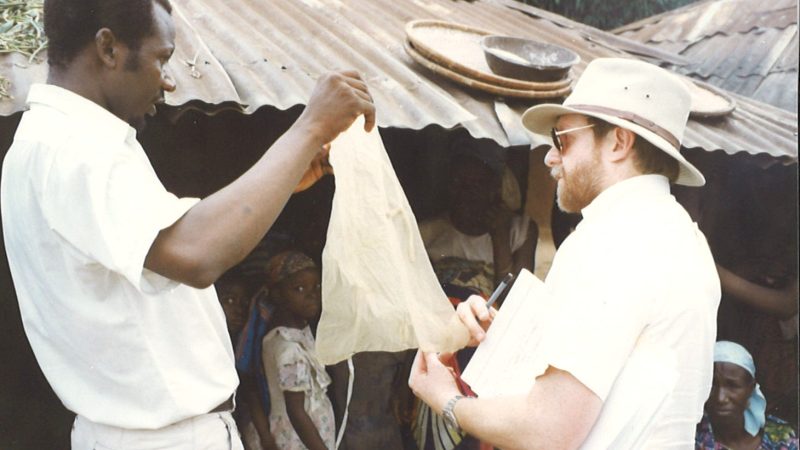
Early in his career, Craig Withers lived in Nigeria, helping the country eliminate Guinea worm disease. Above right, he checks a water filter designed to keep drinking water safe from parasites.

Since the 1980s, Craig Withers has hunted Guinea worms in tens of thousands of African villages, represented former President Jimmy Carter in tense negotiations, and strived to keep more than 3,500 Carter Center staffers safe. Now, after 37 years, 35 countries, and over 3 million Delta miles, Withers is retiring.

“I came to The Carter Center as a Guinea worm warrior, and in my heart of hearts, I’m still a Guinea worm warrior,” he said. “I don’t want to leave without finishing Guinea worm, but the time has come.”

Explore the chapters below to hear, in his own words, the moments that shaped his time at the Center.

Chapter 1: A Little Heineken Goes a Long Way

Chapter 2: Lessons from President Carter

Chapter 3: A Dangerous Mission

Chapter 4: How to Keep 3,500 Staffers Safe

In 1987, the Center’s Dr. Donald Hopkins recruited Withers from the U.S. Centers for Disease Control and Prevention to help map Guinea worm disease in Nigeria’s 95,000 villages. By the following year, Withers was a Carter Center employee living in Nigeria.

While there, Withers was asked to write a speech about Guinea worm to be delivered by head of state Gen. Ibrahim Badamasi Babangida at a Guinea worm donors conference. While writing, inspiration struck. “It was a Saturday afternoon, and I was drinking a Heineken,” he said. “An unvetted idea broke through,” and he added a rogue line to the speech that he was sure would be thrown out later.

At the conference, Withers recalls Gen. Babangida starting the speech, and he appeared to follow Withers’ original text, word for word. Nervously wondering if his rogue line would indeed be delivered, Withers began pacing in the back of the room. Then it happened: “The government of Nigeria will give 7.7 million naira to Guinea worm eradication,” announced Gen. Babangida to the crowd. Withers couldn’t believe it. In his draft, he wrote that Nigeria would donate $1 million. “They changed that to 7. 7 million naira, which meant it was a conscious decision,” Withers said. Add fundraiser to the list of Withers’ roles at The Carter Center.

Over time, Withers took on more responsibilities, including many outside the health arena. President Carter trusted him to speak on his behalf, even sending him to negotiate with the notoriously violent Ugandan rebel leader Joseph Kony. One of the three objectives of that meeting was for Withers and a colleague to come back alive.

Withers said he learned from President Carter how to deal with powerful people.

“First of all, he treats everyone with dignity,” Withers said, still speaking of the late former president in the present tense. “He listens to everybody, and then he responds, but he’s direct. And that’s the way I would conduct my negotiations.… I was always respectful, and we usually found some compromise to solve whatever the issue was.”

Withers exits as vice president of overseas operations, a portfolio that includes everything from purchasing supplies for country offices to hiring security for staff in dangerous conflict zones.

Now he gets to relax and wait for the coming victory over Guinea worm.

“What I have come to understand is that victory is achieved through a war of increments,” he said in a 2009 interview. “A little progress each day is how a battle is won.”

Related Stories

Read More
Read More
Read More